Article: Power conditioner, surge protector or power strip: what your system actually needs
Power conditioner, surge protector or power strip: what your system actually needs
Every note your system plays starts at the wall socket. Before the music becomes sound, it is shaped by the current that powers your amplifier, your source and everything in between. So it is no surprise that the way you distribute power changes how a system sounds.
Three kinds of products are often mentioned in the same breath: surge protectors, power conditioners and power strips made for audio. They do very different things. Knowing the difference helps you protect your equipment and choose what serves the music.
Surge protector: protection, not sound
A surge protector guards your equipment against sudden voltage spikes, for example from lightning or switching in the grid. It contains components that absorb these spikes before they reach your devices.
A surge protector does not change the sound in a positive way, and it is not meant to. Its value is safety. If you live in an area with frequent storms or an unstable grid, protection at the wall or in the main electrical panel is a sensible step.
Good to know: the protective components wear out with every larger surge. A surge protector that has done its job several times may no longer protect as well.
Power conditioner: filtering the mains
A power conditioner works on the quality of the current itself. Most use filters made of capacitors and coils to reduce high-frequency noise on the mains, the kind that comes from switching power supplies, chargers, routers and LED lighting. Some models go further with isolation transformers or by regenerating the current completely.
In many systems this brings a calmer, smoother sound. But filtering has a second side. A filter always takes some energy along with the noise. In a well-balanced, high-resolution system, listeners often notice less air, less fine dynamics and a slightly compressed sound. A conditioner can then smooth over qualities your system already had.
Audiophile power strip: clean distribution
An audiophile power strip takes a different approach. Instead of filtering the current, it distributes it as cleanly as possible. The focus is on what happens between the wall and your components: the wiring, the contacts and the mechanical stability of the strip itself.
This matters more than it might seem. A standard household power strip connects its outlets one after another, uses thin wire and simple contacts, and its plastic housing vibrates along with everything else. Each of these details leaves a small trace in the sound.
Which one do you need?
- If you want protection from storms and grid spikes: a surge protector, ideally at the wall or the main panel, outside the audio chain.
- If your system sounds bright or harsh and your home has a lot of electrical noise: a power conditioner can help, and you may welcome the smoothing.
- If your system is already balanced and you want it to sound more open and natural: clean power distribution, without filtering, usually serves the music better.
These options are not mutually exclusive. Many listeners combine surge protection at the house level with clean distribution in the listening room.
Our approach: distribution without a sound of its own
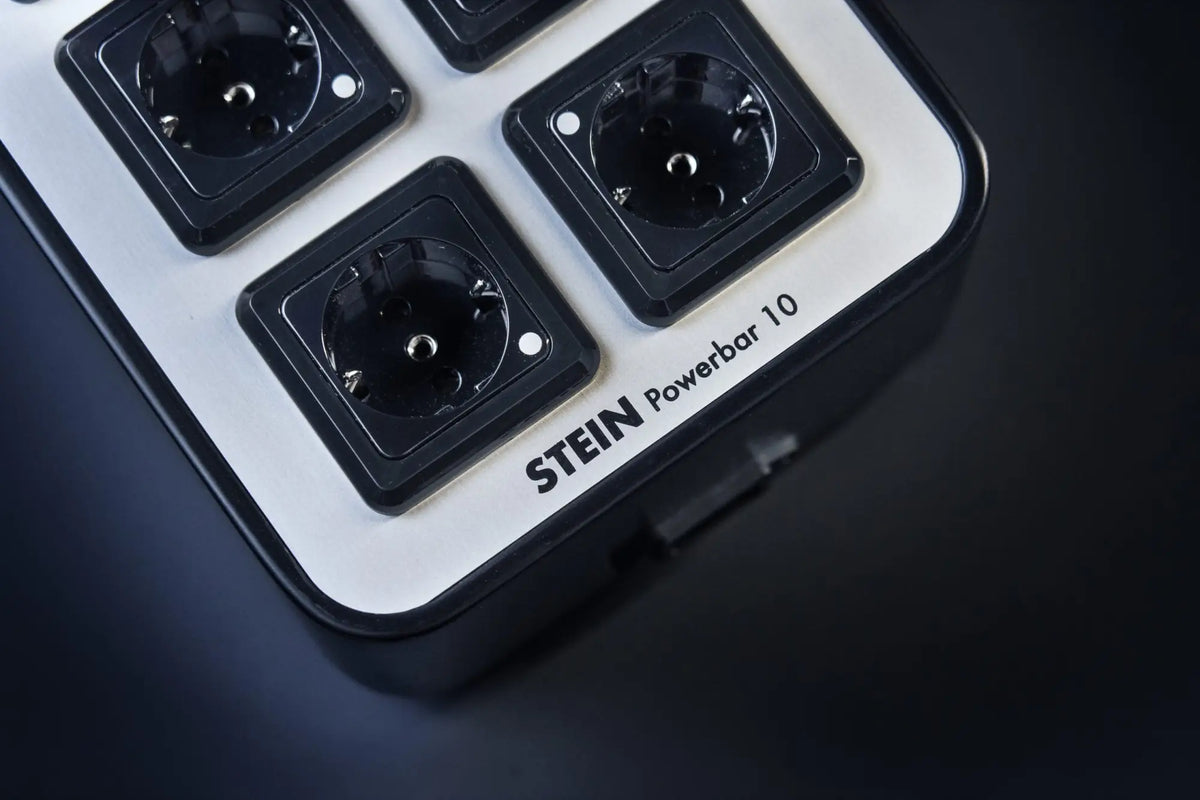
At SteinMusic we chose clean distribution. Our Powerbar 10 and Powerbar 6 are deliberately not filter strips. They have one goal: to bring power to your components without adding a character of their own.
What this means in practice:
- Star wiring with solid copper. Every outlet runs to one central point, so all components share the same reference. This also helps prevent ground loops.
- Precise contacts. The sockets are made to our specification, with partly rhodium-plated contacts for stable, long-term connection.
- A calm housing. A three-layer, CNC-machined body with a grounded carbon composite inside reduces resonance and static charge. Solid walnut feet complete it.
Listeners describe the result as more differentiated and calm, with music that breathes freely.
For systems that benefit from gentle work on the mains, our Q5 Mains Conditioner takes a different route than a classic filter. It uses a high-quality parallel filter with very low losses, combined with our own crystal technology. It plugs into a free outlet of your power strip, and a second unit can go into another socket in the room. Your music keeps its energy, while the mains gains a calmer character.
The Powerbar 10 is available with Schuko or US sockets. UK and Swiss versions are possible on request.
Questions we often hear
What is the difference between a power conditioner and a surge protector?
A surge protector protects equipment from voltage spikes. A power conditioner filters noise on the mains to change how the system sounds. Some products combine both.
Do I need a power conditioner for my audio system?
Not necessarily. In a balanced system, clean distribution without filtering often sounds more open. A conditioner can help if your system sounds harsh or your home has a lot of electrical noise.
Can a power conditioner make my system sound worse?
It can. Strong filtering may reduce fine detail and dynamics. Listen before and after, ideally with music you know well.
Is an audiophile power strip worth it?
It is one of the foundations of a system. Every component draws its power through it, so its wiring and contacts affect everything that follows.